Wednesday, September 15, 2010

Working Title Idea

It's funny how you're not saying things out loud to me.

A little wordy, but just try it on for size... That phrase came along ot me in a bizzare way. Via my coat pocket specifically, on a long folded shred of paper towel and in my handwriting. But I had no memory of how it got there! It was the oddest feeling, before I recognized my handwriting, trying to figure out WHEN it was from, and WHO wrote that to me and why... or when I did recognize it, who I wrote it for, why it was in my pocket and not theirs, and again, WHY was it written? Then I decided I don't really want to know those answers! (Unfortunately, new clues have told me it came from a paper towel at home. I hope not to recall more than this.)

I immediately took the urge to take that little slip of paper seriously, maybe because of the mood I was in when I found it and the personal little crisis that I'm relating it to based on that... but I think it can be applied here. In this dance, we won't be explicit- I imagine we're going to work ourselves to communicating and sharing emotions in a roundabout and clearly nonverbal way. I didn't find amusement in the phrase "it's funny" the first time I read it, instead my stomach dropped as I pressed on to finish the first reading. As I looked at it more, it gathered more dimensions as I hope this dance will. I realized I may have actually been amused when writing it. But there's also a sense of exclusion that touches me. Like the first showing of this piece, there is some confusion as to what it all means, what the feelings behind this are, how it relates to us. Maybe it's silly to give it that kind of weight, but who's to deny something that seems to fit, when something that somehow fits is just what I could use. It feels relevant to my personal processes that relate to the subject of this dance on emotions.

I might decide against it later, but for now, I'm going to see how I like the fit.

IADS Wind Remix

I got a disk with the IAPS and IADS on them today, and I've been having fun beginning to play with editing the sounds! This is just the beginning. I can't quite get the file to post, so that's a technical difficulty I'll need to work out. This may serve as a soundtrack to the pieces, or it could just be inspiration.

Either way, it adds more layers. I'll do a separate post on our first open showing this past Monday and some of my thoughts on the feedback. But after seeing the beginning work performed and the strange power it had, I'm interested in bringing more layers into the piece. As Neta said, let's "see how we can mess it up more." I'd like to look into drawing on more areas of the brain and human experience to add depth to the piece. Rather than being a pared-down version of the stimuli (which everybody would quickly get bored with) let's see how many relevant elements can contribute to what I imagine can be an oddly touching emotional experience pushing itself on the viewers from as many angles as possible.

Friday, September 10, 2010

Communication as meaning-creating

"From a transactional perspective, human communicating is a process of meaning-creating rather than idea- or message-sending. When you're communicating, you're not transmitting your ideas to others but evoking their own ideas or meanings."
-John Stewart in "Listening"

I like this quote because it is as relevant to dance as it is to verbal communication. One of the premises of this dance project is that our dance communications call to the mind of the receiver associations to which they attach meaning, just as our verbal language does, and much like the CSEA stimulus collections do.

Other sources influencing me in this area lately include a New York Times article on the book "Through the Language Glass," this other Times article on how language affects our thinking, and studying for my Listening class (joy).

Rehearsal 4: laughing club and apple seeds

Today's rehearsal was a bit more selective in what we worked with as we focused on the first pleasant emotion we've worked with!

First, we watched videos of people laughing to introduce the idea of that contagion and the social nature of it. Then we did a little Laughter Yoga as a silly warm-up (this is a sample). With this we explored the boundaries of faked and real laughter and how the first can become the second when in a social situation and given the opportunity. We reconsidered the original phrase with the laughter playlist linked above as our soundtrack, and discovered how some of the moves can fit with some of the unusual laughs heard on it.

Moving from this, we worked with some improvisation around the original phrase, and gradually this turned into a game based off of one of the moves which I describe as "dropping apple seeds." Soon enough, the dancers were tossing seeds into each other's mouths, flinging them at each other, and some creative hiding places to avoid seed-theifs. All of this, combined with some of the laughter-movements from earlier became a free-for-all game. For the next rehearsal, I've asked the dancers to each create a bit of movement for a laugh with which they are familiar and we'll see what comes of it next week.


In the attempt to portray emotions and through all the insight from research, I've in some ways lost track of them. Today's rehearsal, particularly with its upbeat topic and somehow freeing degree of focus on making fun allows me to give myself permission to focus on only one emotion for now. The showcase is in October, and my project deadline is in the spring. To fully investigate the emotions to the degree I can imagine would be to make a career out of this project beyond that time frame- however, I hope to have grad school next year. To get ready for the informal showing on Monday evening, for that afternoon's rehearsal, I'd like to work on some sort of structure in which to present what we created today. And for the showcase, I'll plan to show only one, maybe two emotions. But we'll get to the second one when I'm satisfied with the first well enough, so there.


...Now, in the spirit of silliness, enjoy one more video and your weekend!

Rehearsal 3: exhale, jittery, un-focus(ed)

In this rehearsal we experimented with different elements placed on the same movement phrase we've been working with. I first recalled some experimentation I did on my own with the ideas of "give/get/remove/escape" where I found inhales and exhales had an interesting relationship to the associated gestures (mentioned in a previous post). At another point in rehearsal I also chose to look at words that the SAM assessment associates with the concept of "excited": stimulated, jittery, wide-awake, aroused. With these ideas of excited and exhaling as manipulations, we returned to our phrase.

Again, each dancer found her own way to interpret this as we manipulated breathing first, working with focus on the exhales. Differences in the origin of the breath (lungs or stomach) and changes like segmented breaths, pursed lips, or an open mouth were interesting variations. Then we also considered heart rate, so we ran a lap of the dance building and returned to work with the phrase some more. We found that our breathing changed significantly after running, so that deeper "HAA" exhales were easier. It was a challenge to make the movement work with the naturally segmented breath rather then the usual other way around. We also discovered an interesting shift in the sense of release when the dancers were still focused on catching their breath. It was as if they were more free because their bodies were worked up, or they were distracted by the breathing to be freer in the movement. When I introduced the SAM description of excitement, each dancer naturally tended towards a different point along the scale of valence, one positive, one neutral, and one negatively interpreting the idea of excitement. Continuing this part of rehearsal and going off of their natural valences, we also experimented with focus: the dancers described an internal focus as feeling naturally faster, and I need to look again at video in which the dancers tried to maintain a forward focus at the audience to see if any worthwhile effect is found.

You can see above the flighty paths I'm following in leading rehearsals, and I'm realizing with the difficulties of this that I'm resisting the fact that I simply don't have the time to explore in a worthwhile way even a small fraction of the possible "variables" I'd like to have the time to look at. It's just like any psychology experiment- a reasonable researcher would limit the variables and attempt to control for the rest. In this case, control is neither quite possible, nor frankly desirable. But I can still limit my manipulations to focus and have more clear understanding of what I will look at. As we go along, my dancers' patience and feedback helps me to learn ways to focus and better delve into material, and I'll keep at it until we get it right and enjoy doing it!

Monday, August 30, 2010

Rehearsal 2: grieving woman photo

In our second rehearsal, we completed our cast with a third dancer. I briefly introduced the SAM dimensional analysis idea and described how we will draw from both categorical and dimensional theories to inform our adjustments of our movement in the process of illustrating cues for the most basic emotions. I described it as "sliders" along different dimensions of movement quality, and my goal is to determine which dimensions used to what degrees and in what combinations produce the strongest effects. There are lots of possibilities...!

I also began to explain the problem of whether to try to induce what I'll call primary (or first-hand) emotions such as sadness for an unfortunate event in your life, or secondary (or empathetic) responses, such as how I may be saddened by your sadness. I have yet to determine whether it is more effective to, for example, seek to induce fear by actually intimidating the audience, or by demonstrating fear in the movements in hopes of audience identification with the dancers. I could also seek to have them identify with one dancer who is responding to the other two versus identifying with the entire cast at once.


While the IAPS and other databases are out of commission until October (very unfortunate given this semester's showcase timing, but we can work around this), I searched online for other images which fit the short descriptions of the IAPS photos. I considered some "mutilation" images but am not ready to process those in rehearsal yet (given that they're probably a strong part of the need for a release form to view the images, I hesitate to give them to my cast to soon, or at all) ... so today we worked with an image of a grieving woman which could easily have been in the collection.


Before beginning to move, I mentioned Humbert deSuperville's ideas about people's unconditioned reactions to shapes and colors as having emotional significance, so that the down-and-out slopes of this woman's face correlate aesthetically with the sadness that she is expressing. I also noted the tension which I observed and at one point asked that they consider that in their movement. We didn't write out our responses this time, but began moving right away, using the same phrase I taught in the last rehearsal. They quickly moved on to fresh improvisation which really highlighted each dancer's own take on grief, and with this, I realized the richness which each of the three dancers brings to this project. Their three different styles working alongside and with each other works well with my desire to approach this process as creating something that addresses a universal element with roots in individual input, much as averaged data comes out of thousands of single participants, and as an overall message in a dance still has a personal effect that varies between viewers.

Watching them move, I became very interested in their use of negative space, which I at one point prompted them to focus more on that led to some movements I'll hope to use later; to me, this calls to mind the absence of the grief object. Later, movements of grasping for something not present, tension surrounding and through the body, and fixation of one body part on a point stood out to me. Each of the dancers seemed to have one of these qualities that struck me most strongly, and I asked each dancer to focus on what I had noticed in them, which gave diverse and both individually and collectively stronger-feeling results. A sense of precariousness also came into play with all of them at some point, and that is something I think may relate well with grief- as if the emotion were at a tipping point to overwhelming expression at the slightest nudge. And at some points sudden shooting movements our of the tension show pangs of emotion.


At one point I also mentioned the paradox of movement and stillness in grief: that the individual fixates on the object of grief while the world keeps moving, and they also have externally-unseen but internally-overwhelming emotional movements. I found a great article on a series of photos which illustrate this and other elements of grief. The series is called "a dozen useless actions for grieving blondes" by Rosemary Laing, and partway through improvisation I showed the expressive images from the article to my dancers. (I still need to decide about use of facial expressions- that'll come later when we have some other movements set, to see what effects facial options have.) The photo links to the article which has a great analysis of the series. In watching videos of today's work, I think it would be an useful exercise to have one dancer fixed on the spot while others move around the space surrounding her, trying out different distances to see if this paradoxical feeling can be found.


At the close of today's rehearsal, I asked for feedback from the dancers, and I was given an important reminder of the need for humanity behind what has become objective and academic for me during the summer research phase of this project. According to a request from one dancer -whose pensive style was part of why I asked her to work with me- I will make upcoming stimuli available to them in order to allow the dancers time to process and personally relate to the material that I'm asking them to embody. While I have ideas of in some ways imitating the experience of being an IAPS study participant for the dance audience, that does not mean that the dancers need to have that limited brief exposure. (And with a maximum of 8 minutes to present a few basic emotions at the upcoming Fall BFA showcase, exposure time will be short enough. We'll see how condensed we can make this!) I want to respect and take advantage of each of these dancers' unique ways of processing the material and working in dance; I'll maintain the research end of things, but they are the ones who I am looking to to embody and expand my ideas which I'll pare down to our eventual final work, so I'll look forward to how this change in our process can enrich things.

Finally, in reviewing videos of our rehearsals so far, I'm hoping to start improving how I lead improvisation, to make my prompts less general and more helpful. That will also come as we work together more, I hope. We're looking to continue practicing an hour and a half twice a week, once we find regular studio space!

Rehearsal 1: snake and homeless images

We've had two rehearsals so far, and it's been an interesting experience for me. I appreciate the three dancers who've joined me, and while a good part of our time so far has been spent explaining the gist of the project and subject matter, and ennumerating the many choreographic choices I'll have to make, we spent some good time looking at a few emotional images, discussing, and improvising. These images so far have been presented during rehearsal, so the dancers had little time to process them, but I think that we've addressed certain elements for each that will contribute to my first goal of generating ideas from which we will select later to focus on. At the first rehearsal, there were two dancers.

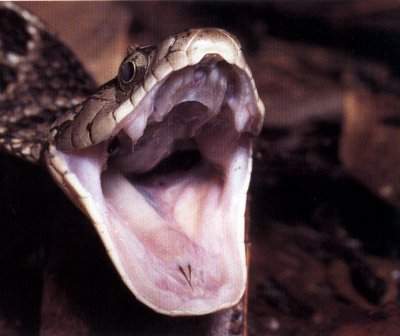
First, we discussed the image below. Personally, I am struck by certain aesthetic aspects of the photograph (so my input is an interpretation of an interpretation- which will continue to happen through this kind of work). The body of the snake rises out of darkness, creating contrast; there is forward movement, aggression, a primacy of action over foresight (with the mouth larger than the eye); and a sense of falling in (the mouth) vs. striking out, and round/smoothness vs. sharpness (curved fangs). Discussion with another dancer also brought up how snakes are unpredictable (including when we can't remember the "rules" of them, such as which are poisonous), and they are deceptive (I think even their appearance deceives: they aren't slimy though they look so). He also felt that they are vindictive without reason, which reminds me how we give human characteristics out so easily (which may make for more emotional experiences in some cases), and reminded me of the relationship between anger and fear, which will be better explored later I think. My dancers' reponses included phrases like "danger, open, escape response" and "'ahhh!' fear, scary, big, killer, escape; from the snake's perspective: attack, anger." From these responses, I asked the two dancers to improvise with an original phrase I taught them and the ideas of being like the snake as structures (with Massive Attack's "Antistar" playing softly). As I lead more improvisation, I hope to improve at clarifying instructions at the start- but as we went along, I requested more aggression, and became interested in the contrast of pulsating waiting and sudden larger movements which as I watched I felt characterized a snake. I requested more aggression directed towards me, and I think a stronger sense of dominance might help to inspire a more fear-like reaction in the viewer. Finally for this image, a request for "suddenness" yielded some effective movements that I'll look at for later use.

The other image that we looked at in the first rehearsal was of a "hobo", according to the IAPS descriptions (the actual image is not shown here to avoid copyright problems, but here is a somewhat similar image). The man in the actual picture is seated in a dark place and has a dirty face in such a way that he looks almost skeletal, he is drinking from a yellow glass bottle, and within the dark image, next to him are highlighted a loaf of bread and two more bottles on a piece of cloth. The drink and food remind me of the idea of gluttony, which can be disgusting or repulsive. When I look at the image, textures are very evident to me, in the black grease on his face, the roughness of the wall and brick behind him, and the cloth and crumbs net to him. I related this noticeable variety of "dirty" textures to how people respond to disgust. In a course on social cognition, I learned that people de-humanize the homeless to the point that we tend to think of them as having less human characteristics than dogs (which I believe shows up in brain scans- I need to find the research to reference). We also learned that people relate moral/mental dirtiness to physical dirtiness, so that when people who are "disgusted" by an idea are allowed to literally wash their hands, they feel better afterwards (also will look up that article to reference). The dancers noticed the dark, gruesome colors of the IAPS image, and also wrote "thirst, dark, cold, age/hunger in the defined cheekbone, bright hand sticks out" and "dark, chill, hydrate, drunk, escape (through drunkenness), trapped on the streets, lost, going anywhere?" We wondered what happened to him- but aside from re-humanizing him (and losing the sense of being at least somewhat initially repulsed that I hoped to look into at the time), I wanted to maintain the jerk-reaction urge to distance ourselves from the stimulus. For improvisation on this image, I particularly asked to see the texture that struck me in the photo, and the sense of the thickness of space that they created felt satisfying to me. One dancer pulled her hood over her head and faced upstage, which was an interesting way to remove herself from seeming fully human. Writhing, rubbing, sliding, crouching, and self-manipulation (one limb moving another) all appeared during this section of the improvisation. Next, I asked for them to show me something "repulsive" so as to cause me to feel disgust. The movements in response to this included reference to sexual exploitation which was a unique take on the prompt that led to some interesting movements, and also low-to-the-ground crawling/writhing.